Platform rules are a cost
Marketplace sellers need to price for fulfilment, advertising, returns, storage and policy changes rather than treating online reach as free demand.
Source: Amazon Seller Central
Business guides
A Houston Amazon store makes the most sense when the founder treats the city as a logistics base, not as a branding fantasy, and keeps the whole model lean until product economics are actually proven.
Overview
Houston gives online sellers some natural advantages: broad warehouse and flex-space options, a large labour pool, the Port of Houston, and the appeal of Texas with no state income tax for individuals. None of that replaces the hard work of picking products, managing prep, handling returns and keeping cash out of dead inventory. The right setup might be home-based, shared-space or small-warehouse depending on the product, but each comes with different workflow and storm-risk implications. Use the simulator to test landed margin, storage, shipping, ad spend and owner time before assuming scale will rescue a weak product choice.
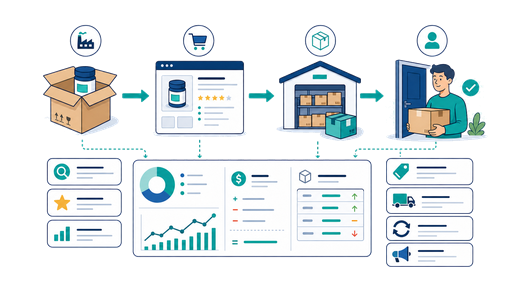
Key stats
Platform rules are a cost
Marketplace sellers need to price for fulfilment, advertising, returns, storage and policy changes rather than treating online reach as free demand.
Source: Amazon Seller Central
Cash flow comes first
E-commerce can grow sales while consuming cash through inventory buys, ad spend and delayed payouts.
Source: SBA
Consumer law still applies
Online sellers still need clear claims, returns handling and truthful pricing.
Source: ACCC
Key concepts
Houston’s warehouse corridors can make expansion look easy too early. Begin with the smallest space that supports orderly receiving, prep and dispatch, then grow only when the SKU mix and reorder rhythm justify it.
Home-based setups can work at the start, but only if zoning, storage, safety and storm contingency are realistic. Cheap flex space is not cheap if the workflow becomes sloppy or the rent runs ahead of sales proof.
Online branding matters, but the real work is sourcing, quality checks, barcode prep, packing, customer service and returns. Houston weather and hurricane threats also make backup stock protection and continuity planning worth pricing early.
Texas having no state income tax does not remove the need to understand sales tax, entity structure, insurance and payroll if you add help. Treat compliance as part of the operating system, not as a later fix.
Audience and industry
Customers for a Amazon online store in Houston should be described by routine, not by broad demographics. Identify who buys, when they buy, how often they return, what alternatives they compare, and how far they will travel. For this business, the first demand hypothesis to prove is search demand, product-market fit and review trust.
E-commerce attracts many Houston side-hustle founders because the entry story feels accessible. The stronger businesses behave like disciplined operations companies: tight SKU logic, careful replenishment, clean prep systems and a realistic view of sales tax, packaging and return friction.
Competition in Houston is not just the nearest similar operator. Include substitutes, online options, supermarkets, gyms, marketplaces, delivery platforms, shopping centres, petrol sites, home alternatives and any business that solves the same customer problem. Visit competitors at the same times you expect to trade.
Key factors
Proof of search demand, product-market fit and review trust in the exact Houston catchment.
Rent, outgoings, lease obligations and fit-out spend compared with conservative sales.
catalogue quality, fulfilment choice, customer service and stock discipline
gross margin after fees, ads, returns and stock-outs
Enough cash to survive delays, learning, seasonality and slower repeat-customer growth.
Finance model
Business Model Canvas
Specific Houston customers with repeat need for search demand, product-market fit and review trust.
A Amazon store offer that is easier, faster, more trusted or more local than the alternatives.
Street visibility, local search, referrals, social proof, partnerships, delivery or marketplace channels as appropriate.
Sales driven by search demand, product-market fit and review trust; test price, volume and repeat rate separately.
referral fees, fulfilment fees, advertising, returns and landed product cost; split fixed costs, variable costs and launch costs.
catalogue quality, fulfilment choice, customer service and stock discipline
A suitable site or channel, trained people, reliable suppliers, systems, permits and enough runway.
Landlord, suppliers, advisers, local marketers, delivery or fulfilment providers, and maintenance support.
Evidence-based assumptions, staged spending, conservative break-even checks and clear exit conditions.
Common mistakes
Chasing too many random SKUs
Stay narrow until one product family proves margin, workflow and reordering logic.
Leasing more space than the workflow needs
Choose space for prep efficiency, not for image or optimism.
Ignoring cash tied up in inventory and ads
Track payout timing, reorder needs and advertising dependency before scaling.
Case studies
A compact scenario showing how one assumption can change the result.
A compact scenario showing how one assumption can change the result.
Decision tree
Move to rent, capacity and margin stress tests.
Keep researching, pre-selling or testing with a smaller commitment.
Review startup risk, funding and compliance with advisers.
Renegotiate rent, reduce scope, change location or pause.
Prepare a launch plan with measured weekly review points.
Fix capacity, staffing, supplier or process constraints before spending more.
Self-evaluation
Early stage: tighten the assumptions before treating this as feasible.
Decision point
Use the simulator as a structured sanity check. It should support adviser conversations, not replace them.
Test your idea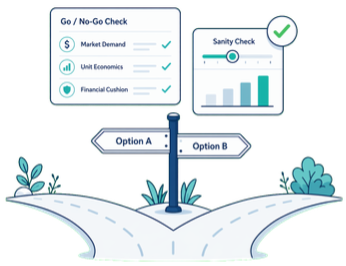
Where you trade
The guide above works as a planning framework. Confirm the rules, taxes and local context below before you commit.

Checklist
FAQ
It can, because the metro offers logistics infrastructure, labour access and flexible storage options. The opportunity still depends on disciplined product economics and clean operations, not on city size alone.
Not always. Many founders can start from home or a very small flex setup if storage, safety and workflow are realistic for the products involved.
Validate landed margin, storage needs, prep workflow, return handling, storm resilience and the cash required to keep replenishment healthy.
No. It is early planning support to help you structure assumptions before seeking qualified advice on finance, tax, lease, employment and compliance matters.
Sources
Disclaimer: smallbizsim.com provides indicative planning estimates only. It is not financial, legal, tax or investment advice. Verify assumptions with qualified advisers before making decisions.