Utilities can decide the model
Equipment-heavy businesses should stress-test power, water, repairs and downtime before trusting revenue projections.
Source: SBA
Business guides
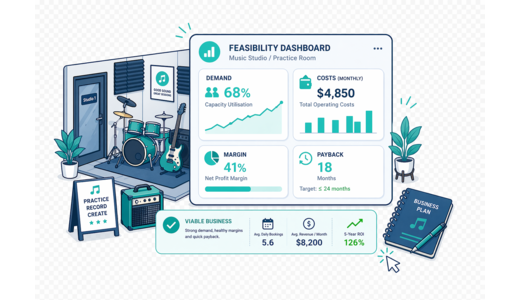
Practice rooms and studios are capacity businesses disguised as creative spaces. The model depends on booked hours, acoustic quality, equipment care and whether musicians return.
Localise this guide
Overview
The studio works when rooms are booked often enough at the right rate to pay for acoustic fit-out, equipment and downtime. In practical terms, this is the music studio investment story about local music schools, venues, rehearsal waitlists, online booking interest and competitor room quality gaps, hourly room rate, block bookings, memberships, lessons, recording add-ons and equipment hire, and the discipline to avoid spending heavily on acoustic fit-out before proving enough paid booked hours.
Key stats
Utilities can decide the model
Equipment-heavy businesses should stress-test power, water, repairs and downtime before trusting revenue projections.
Source: SBA
Capital is locked in early
Fit-out, machinery, lease works and maintenance reserves make staged spending more important than a glossy launch.
Source: business.gov.au
Location still matters
Even semi-automated operations need the right catchment, access, parking and visibility.
Source: SCORE
Key concepts
Model rooms by hour, daypart and realistic utilisation.
Evening and weekend slots may be valuable while weekday hours need lessons or production use.
Cancellations and setup time should be included.
Poor isolation damages reviews and neighbour relationships.
Equipment repair and replacement reserves are part of the model.
Access, parking and safety matter when musicians carry gear at night.
Audience and industry
This guide is for founders, buyers and side-hustle operators asking whether the music studio deserves more time, money and professional due diligence.
Creators need physical space, but demand is local and time-specific; empty rooms are perishable inventory.
Compare schools, community halls, home studios, churches, rehearsal spaces and online production workflows.
Key factors
local music schools, venues, rehearsal waitlists, online booking interest and competitor room quality gaps
hourly room rate, block bookings, memberships, lessons, recording add-ons and equipment hire
room count, sound isolation, booking calendar, equipment reliability and late-night access rules
spending heavily on acoustic fit-out before proving enough paid booked hours
a reliable creative home: clean rooms, good sound, easy booking and equipment that works every time
Finance model
Business Model Canvas
bands, teachers, students, podcasters, producers and musicians needing reliable rooms or recording support
a reliable creative home: clean rooms, good sound, easy booking and equipment that works every time
Volume multiplied by realised price, with add-ons and repeat frequency tested separately.
Direct costs first, then rent, wages, utilities, software, maintenance, marketing and startup capital.
Conservative assumptions, staged spending, local quotes and clear break-even checks before commitment.
Common mistakes
Mistaking opening-week attention for repeat demand.
Separate curiosity traffic from customers who return at sustainable prices.
Letting the lease decide the business model.
Model rent and fixed costs against a conservative demand case before signing.
Ignoring the operating bottleneck.
Check room count, sound isolation, booking calendar, equipment reliability and late-night access rules before assuming more sales are physically possible.
Underfunding the ramp-up period.
Keep working capital for delays, training, mistakes, repairs and slower-than-planned demand.
Case studies
A compact scenario showing how one assumption can change the result.
A compact scenario showing how one assumption can change the result.
Decision tree
Move to quote-based costing and capacity stress tests.
Pause spending and collect better local evidence first.
Test whether the upside case is operationally deliverable.
Reduce fixed costs, narrow the offer or find a different site.
Turn that promise into menu, pricing, staffing and marketing decisions.
Sharpen the concept before committing capital.
Self-evaluation
Early stage: tighten the assumptions before treating this as feasible.
Decision point
Use the simulator as a structured sanity check. It should support adviser conversations, not replace them.
Test your idea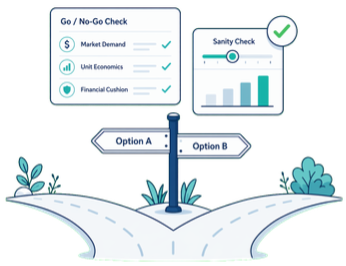
Where you trade
The guide above works as a general planning framework. Pick your country for rules, taxes and local context.

Checklist
FAQ
Start with conservative local evidence for demand, pricing, direct costs, staffing, rent and startup money. The simulator turns those assumptions into revenue, cost, profit, break-even and payback outputs.
No. Calculations are deterministic and based on the assumptions you enter. AI-generated text only explains results and does not recompute them.
No. It is an early planning tool to help you ask better questions before speaking with an accountant, broker or qualified adviser.
Use the optional independent-versus-franchise comparison with the terms from the disclosure document and agreement. Treat the initial fee as startup capital; enter the royalty and brand fund as percentages of modeled gross revenue; and enter required local marketing as a monthly fixed cost in addition to your existing local marketing budget. Confirm the eligible gross-revenue definition, supplier restrictions, territory, renewal, transfer and exit conditions before relying on the comparison.
Sources
Disclaimer: smallbizsim.com provides indicative planning estimates only. It is not financial, legal, tax or investment advice. Verify assumptions with qualified advisers before making decisions.