Value pressure
Restaurant research keeps pointing to price sensitivity, convenience and memorable experience as the themes operators must design around.
Source: McKinsey
Business guides
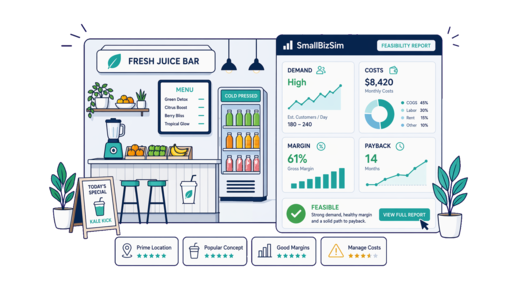
A juice bar sells freshness, energy and convenience. Feasibility depends on produce yield, prep speed, waste, foot traffic and whether the health promise is specific enough to earn repeat visits.
Localise this guide
Overview
The model works when fresh ingredients become high-value repeat drinks before spoilage and labour consume the margin. In practical terms, this is the fresh juice bar investment story about morning/lunch foot traffic, nearby gyms or offices, health retail clusters and repeat drink routines, produce yield, average ticket, smoothie add-ons, prep labour, waste and supplier pricing, and the discipline to avoid buying premium equipment and too much fresh stock before proving daily sell-through.
Key stats
Value pressure
Restaurant research keeps pointing to price sensitivity, convenience and memorable experience as the themes operators must design around.
Source: McKinsey
Food safety is not optional
Food businesses need documented food handling, allergen and hygiene processes before launch, not after the first complaint.
Benchmark the margins
Tax-office small-business benchmarks are useful sense checks for food cost, labour and rent assumptions, even though your site still needs its own model.
Source: ATO
Key concepts
Track how much sellable drink comes from each box of produce.
Waste should be forecast by ingredient because berries, greens and citrus behave differently.
A menu built around shared ingredients reduces spoilage.
Customers should understand the benefit without reading a nutrition essay.
Functional add-ons can lift ticket size, but only when cost and demand are proven.
Speed matters: a “healthy” drink still loses if the queue is slow.
Audience and industry
This guide is for founders, buyers and side-hustle operators asking whether the fresh juice bar deserves more time, money and professional due diligence.
Health-led convenience is attractive, but customers still judge price, speed and taste before wellness claims.
Compare cafes, gyms, supermarkets, bubble tea, smoothie chains and convenience drinks.
Key factors
morning/lunch foot traffic, nearby gyms or offices, health retail clusters and repeat drink routines
produce yield, average ticket, smoothie add-ons, prep labour, waste and supplier pricing
prep space, juicer/blender speed, refrigeration, queue flow and staff training
buying premium equipment and too much fresh stock before proving daily sell-through
a focused health lane: post-gym smoothies, cold-pressed premium, office breakfast, functional shots or affordable fresh blends
Finance model
Business Model Canvas
commuters, gym-goers, students, office workers and health-focused locals buying a quick fresh drink or snack
a focused health lane: post-gym smoothies, cold-pressed premium, office breakfast, functional shots or affordable fresh blends
Volume multiplied by realised price, with add-ons and repeat frequency tested separately.
Direct costs first, then rent, wages, utilities, software, maintenance, marketing and startup capital.
Conservative assumptions, staged spending, local quotes and clear break-even checks before commitment.
Common mistakes
Mistaking opening-week attention for repeat demand.
Separate curiosity traffic from customers who return at sustainable prices.
Letting the lease decide the business model.
Model rent and fixed costs against a conservative demand case before signing.
Ignoring the operating bottleneck.
Check prep space, juicer/blender speed, refrigeration, queue flow and staff training before assuming more sales are physically possible.
Underfunding the ramp-up period.
Keep working capital for delays, training, mistakes, repairs and slower-than-planned demand.
Case studies
A compact scenario showing how one assumption can change the result.
A compact scenario showing how one assumption can change the result.
Decision tree
Move to quote-based costing and capacity stress tests.
Pause spending and collect better local evidence first.
Test whether the upside case is operationally deliverable.
Reduce fixed costs, narrow the offer or find a different site.
Turn that promise into menu, pricing, staffing and marketing decisions.
Sharpen the concept before committing capital.
Self-evaluation
Early stage: tighten the assumptions before treating this as feasible.
Decision point
Use the simulator as a structured sanity check. It should support adviser conversations, not replace them.
Test your idea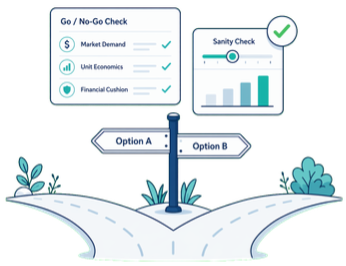
Where you trade
The guide above works as a general planning framework. Pick your country for rules, taxes and local context.

Checklist
FAQ
Start with conservative local evidence for demand, pricing, direct costs, staffing, rent and startup money. The simulator turns those assumptions into revenue, cost, profit, break-even and payback outputs.
No. Calculations are deterministic and based on the assumptions you enter. AI-generated text only explains results and does not recompute them.
No. It is an early planning tool to help you ask better questions before speaking with an accountant, broker or qualified adviser.
Use the optional independent-versus-franchise comparison with the terms from the disclosure document and agreement. Treat the initial fee as startup capital; enter the royalty and brand fund as percentages of modeled gross revenue; and enter required local marketing as a monthly fixed cost in addition to your existing local marketing budget. Confirm the eligible gross-revenue definition, supplier restrictions, territory, renewal, transfer and exit conditions before relying on the comparison.
Choose exactly one method: total monthly payroll, hours multiplied by hourly rate, or a detailed staff roster. Do not enter the same owner or staff cost in more than one method, and do not duplicate an owner cost in both payroll or the roster and a separate owner-cost field.
Sources
Disclaimer: smallbizsim.com provides indicative planning estimates only. It is not financial, legal, tax or investment advice. Verify assumptions with qualified advisers before making decisions.