This guide is for educators, centre operators and buyers testing a tutoring venue before committing to classrooms, curriculum and administration.
Business guides
Can your tutoring centre idea work?
Before you lease classrooms or build a curriculum, test how enrolments, session frequency, group size, tutor pay and room capacity translate into a sustainable centre.
Try the simulator →
Individual and group tutoring revenueRevenue mix
Session demand compared with available tutoring roomsCapacity view
Break-even, payback and cost pressureCommitment check
Overview
Start with the business model, not the dream.
A tutoring centre earns through teaching time, but its economics depend on how students, tutors and rooms fit together. Individual sessions can support a clear premium service, while group sessions can spread teaching time across more students when enrolments are strong enough. Neither path works automatically: weak attendance leaves rooms and tutors underused, and optimistic group sizes can overstate revenue before a class is proven. A sound feasibility test starts with enrolled students and realistic weekly frequency, then separates individual and group demand, tutor pay, materials and payment costs. Fixed commitments such as rent, administration, software and curriculum setup should be judged against a conservative teaching schedule rather than a fully occupied timetable.

Key concepts
Terms that shape the financial story.
- Student-session demand
- Enrolment becomes revenue only when students attend paid sessions at the frequency used in the model.
- Teaching mix
- Individual and group sessions have different prices, tutor requirements and room-use patterns.
- Room utilisation
- Rooms are useful only when the timetable places paid sessions into the available teaching days without unrealistic overlap.
- Tutor economics
- Tutor pay belongs beside session demand because teaching cost changes as the timetable expands.
A timetable is only valuable when students fill it
A long course list can look impressive while spreading a small enrolment base too thinly. Start with the subjects and time slots for which you have direct local evidence, then build the timetable around those students.
Treat group size as an assumption to prove, not a guaranteed efficiency. A group session with too few paying students still consumes tutor time and a room, while an overfilled group may weaken the service being sold.
Separate teaching cost from centre overhead
Tutor pay and student materials change with session activity. Rent, administration, software, utilities and insurance continue even when the timetable is soft. Keeping those cost groups separate makes the break-even question easier to understand.
Room count should follow the timetable. Test whether available teaching days can support the proposed individual and group sessions before paying for extra classrooms.
Audience and industry
Understand who pays, why they choose you, and who else competes.
Tutoring customers compare subject fit, teaching quality, convenience, trust and outcomes across centres, independent tutors and online services. Local proof and a workable timetable matter more than a broad unsupported course list.
Compare local tutoring centres, independent tutors, school programs and online platforms by subject coverage, scheduling, teaching quality, price and parent or student trust.
- A clear student segment and subject promise.
- A timetable built around proven enrolment and room capacity.
- Reliable tutors and communication that support repeat attendance.
- A deliberate balance of individual and group teaching.
Key factors
The few variables that usually decide feasibility.
Enrolled student demand
Student count and paid session frequency drive the individual teaching base.
Group fill
Per-student group revenue depends on real attendance rather than nominal class capacity.
Tutor pay
Teaching cost should rise with the sessions tutors deliver.
Room use
The centre should not carry more classroom space than its realistic timetable can use.
Finance model
How the money usually moves through this business.
Unit economics
- Individual session price less tutor pay and materials
- Group revenue per session less tutor pay and per-student materials
- Payment cost across teaching revenue
Cost structure
- Tutor pay and teaching materials
- Rent, admin wages, software, utilities and insurance
- Marketing and other fixed centre costs
Funding
- Fit-out, classroom equipment and lease bond
- Curriculum setup and launch marketing
- Working capital while enrolments and the timetable build
Business Model Canvas
Map the operating logic on one page.
Customer segments
Students and families seeking subject support, exam preparation or structured learning.
Value proposition
Trusted teaching with a clear subject fit, convenient timetable and visible learning process.
Revenue streams
Individual sessions and per-student group sessions.
Key activities
Teaching, tutor management, timetabling, enrolment, communication and curriculum upkeep.
Cost structure
Tutor pay, materials, admin wages, rent, software, utilities and marketing.
Common mistakes
Risks to remove from the plan early.
Mistake
Assuming every planned group session will be full.
Fix
Use conservative group sizes and test weaker enrolment before expanding the timetable.
Mistake
Counting enrolment without session frequency.
Fix
Translate each enrolled student into realistic paid sessions per week.
Mistake
Leasing rooms for future growth too early.
Fix
Match room count to the conservative timetable and evidence for peak demand.
Decision point
Ready to test your own assumptions?
Use the simulator as a structured sanity check. It should support adviser conversations, not replace them.
Test your idea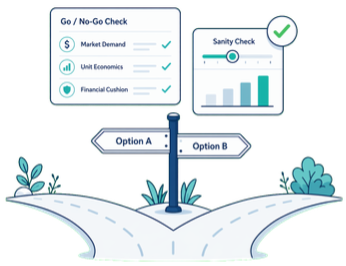
Checklist
Use this as a practical review list.
0 of 4completed
FAQ
Common questions
What should I test for a tutoring centre?
Test enrolled students, session frequency, individual and group pricing, group size, tutor pay, materials, room capacity, admin wages, rent and setup capital.
Why model individual and group sessions separately?
Individual and group sessions use rooms, tutors and materials differently. Separating them shows whether the planned teaching mix can cover its direct and fixed costs.
Is this financial advice?
No. It is an early planning tool to help you ask better questions before speaking with an accountant, broker or qualified adviser.
How should I compare an independent business with a franchise?
Use the optional independent-versus-franchise comparison with the terms from the disclosure document and agreement. Treat the initial fee as startup capital; enter the royalty and brand fund as percentages of modeled gross revenue; and enter required local marketing as a monthly fixed cost in addition to your existing local marketing budget. Confirm the eligible gross-revenue definition, supplier restrictions, territory, renewal, transfer and exit conditions before relying on the comparison.
Disclaimer: smallbizsim.com provides indicative planning estimates only. It is not financial, legal, tax or investment advice. Verify assumptions with qualified advisers before making decisions.