Utilities can decide the model
Equipment-heavy businesses should stress-test power, water, repairs and downtime before trusting revenue projections.
Source: SBA
Business guides
A music studio in Birmingham has to plug into a real scene: artists, producers, teachers, podcasters or creators who can return often enough to fill the rooms. The city gives cultural depth and often more affordable space than London, but acoustic build-out and off-peak use still decide the economics.
Overview
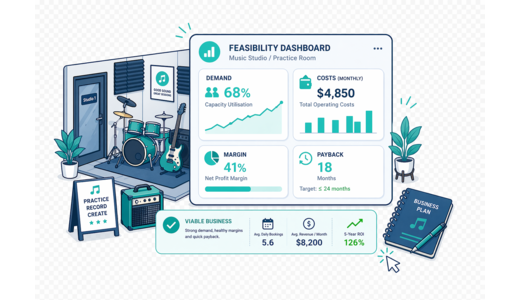
Music-studio feasibility depends on recurring client segments, not on a vague hope that creative people will discover the room. Digbeth, student talent from BCU, UoB and Aston, and the wider second-city music ecosystem all create opportunity, but the operator still needs clear use cases such as rehearsal, recording, tuition or content creation. Use the simulator to test room utilisation, engineer time, equipment replacement and soundproofing cost before taking a lease.
Key stats
Utilities can decide the model
Equipment-heavy businesses should stress-test power, water, repairs and downtime before trusting revenue projections.
Source: SBA
Capital is locked in early
Fit-out, machinery, lease works and maintenance reserves make staged spending more important than a glossy launch.
Source: business.gov.au
Location still matters
Even semi-automated operations need the right catchment, access, parking and visibility.
Source: SCORE
Key concepts
A rehearsal studio in Digbeth, a vocal-recording room for local artists or a creator suite for podcasts are different businesses. Define the main user and their recurring booking pattern before you decide the room spec or equipment list.
Birmingham has strong music history and live-culture energy, but culture alone does not fill weekday afternoons. The best studios usually combine scene credibility with a practical booking rhythm.
Affordable creative space can look attractive compared with London, yet the wrong walls, neighbours or access rules can destroy the concept. Acoustic treatment, ventilation and building permissions should shape site choice before rent is compared.
Equipment replacement and technical downtime belong in the base case. A studio is not only a room rental business; it is also a reliability business.
Audience and industry
Customers for a music studio or practice room business in Birmingham should be described by routine, not by broad demographics. Identify who buys, when they buy, how often they return, what alternatives they compare, and how far they will travel. For this business, the first demand hypothesis to prove is repeat local demand, visible catchment fit and sustainable booking or transaction volume.
Competition is often fragmented, which can leave room for a better booking experience, more reliable equipment or stronger genre credibility. The biggest risk is a beautiful room that sits empty through too many off-peak hours.
Competition in Birmingham is not just the nearest similar operator. Include substitutes, online options, supermarkets, gyms, marketplaces, delivery platforms, shopping centres, petrol sites, home alternatives and any business that solves the same customer problem. Visit competitors at the same times you expect to trade.
Key factors
Proof of repeat local demand, visible catchment fit and sustainable booking or transaction volume in the exact Birmingham catchment.
Rent, outgoings, lease obligations and fit-out spend compared with conservative sales.
capacity utilisation, staffing coverage, customer experience, stock or equipment control and repeat sales routines
contribution margin after direct costs, labour pressure and occupancy cost
Enough cash to survive delays, learning, seasonality and slower repeat-customer growth.
Finance model
Business Model Canvas
Specific Birmingham customers with repeat need for repeat local demand, visible catchment fit and sustainable booking or transaction volume.
A music studio offer that is easier, faster, more trusted or more local than the alternatives.
Street visibility, local search, referrals, social proof, partnerships, delivery or marketplace channels as appropriate.
Sales driven by repeat local demand, visible catchment fit and sustainable booking or transaction volume; test price, volume and repeat rate separately.
rent, wages, supplies, product cost, utilities, insurance and payment fees; split fixed costs, variable costs and launch costs.
capacity utilisation, staffing coverage, customer experience, stock or equipment control and repeat sales routines
A suitable site or channel, trained people, reliable suppliers, systems, permits and enough runway.
Landlord, suppliers, advisers, local marketers, delivery or fulfilment providers, and maintenance support.
Evidence-based assumptions, staged spending, conservative break-even checks and clear exit conditions.
Common mistakes
Taking a unit before confirming acoustic suitability
Let soundproofing, building tolerance and access rules determine viability before you fall for low rent.
Depending on vague scene demand
Build the model around specific recurring user groups and known session types.
Ignoring equipment replacement and technical support
Include maintenance, downtime and refresh cycles in the operating plan from the start.
Case studies
A compact scenario showing how one assumption can change the result.
A compact scenario showing how one assumption can change the result.
Decision tree
Move to rent, capacity and margin stress tests.
Keep researching, pre-selling or testing with a smaller commitment.
Review startup risk, funding and compliance with advisers.
Renegotiate rent, reduce scope, change location or pause.
Prepare a launch plan with measured weekly review points.
Fix capacity, staffing, supplier or process constraints before spending more.
Self-evaluation
Early stage: tighten the assumptions before treating this as feasible.
Decision point
Use the simulator as a structured sanity check. It should support adviser conversations, not replace them.
Test your idea
Where you trade
The guide above works as a planning framework. Confirm the rules, taxes and local context below before you commit.

Checklist
FAQ
Creative areas such as Digbeth can work well, but the best site is the one with the right acoustic potential, access hours and recurring client base. Lower rent is only useful if the property really suits the format.
Break demand into recurring user groups such as bands, solo artists, teachers or podcasters, then map how often and when they would realistically book.
Validate soundproofing potential, neighbour sensitivity, access rules, load-in, equipment needs and how you will fill quieter off-peak hours.
No. It is early planning support to help you structure assumptions before seeking qualified advice on finance, tax, lease, employment and compliance matters.
Sources
Disclaimer: smallbizsim.com provides indicative planning estimates only. It is not financial, legal, tax or investment advice. Verify assumptions with qualified advisers before making decisions.