Retention beats hype
Wellness studios depend on recurring visits, instructor trust and a calendar that turns first-timers into habits.
Source: Yoga Alliance
Business guides
In Austin, a massage shop grows when it is easy, friendly and tuned to fast-moving neighborhoods. Practical convenience with a bit of charm goes a long way in Austin. Professional trust is the moat; every marketing tactic should reinforce it.
Overview
Population growth and a young renter-heavy base support repeat service businesses, especially those that solve convenience or self-care. For massage shops, stress, pain relief and wellness routines create demand, but trust and professionalism shape conversion. Competition is intensifying as the city grows, so operators need strong identity and practical heat-proof operations. Licensing, room utilization and referral flow matter as much as ambience. Customers are responsive to local buzz, app-friendly booking and businesses that respect the heat and traffic reality. Customers often arrive through nearby work, fitness, hospitality or word-of-mouth channels and stay only if booking feels effortless. Use the simulator to test the Austin-specific assumptions behind massage shop demand instead of relying on citywide hype or a single busy day.
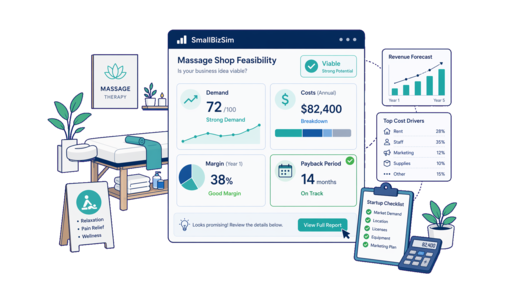
Key stats
Retention beats hype
Wellness studios depend on recurring visits, instructor trust and a calendar that turns first-timers into habits.
Source: Yoga Alliance
Credentials matter
Massage and movement businesses should treat training, scope of practice and insurance as commercial trust signals as well as compliance checks.
Source: AMTA
Wages move break-even
Award rates, contractor settings and penalty rates can materially change the class or appointment volume needed to break even.
Source: Fair Work Ombudsman
Key concepts
Population growth and a young renter-heavy base support repeat service businesses, especially those that solve convenience or self-care. For massage shops, stress, pain relief and wellness routines create demand, but trust and professionalism shape conversion. In practice that means proving why this massage shop belongs in a precise Austin micro-market such as Rainey Street and North Loop rather than assuming the whole city behaves the same.
Use site visits to test licensing and compliance, treatment-room economics and how heat, traffic, patio culture, food-truck competition or live-music spillover change ordinary trading days.
Competition is intensifying as the city grows, so operators need strong identity and practical heat-proof operations. Licensing, room utilization and referral flow matter as much as ambience. Model packages and memberships and ambience and trust signals with real quotes so the plan still works outside launch excitement.
Customers are responsive to local buzz, app-friendly booking and businesses that respect the heat and traffic reality. Customers often arrive through nearby work, fitness, hospitality or word-of-mouth channels and stay only if booking feels effortless. Practical convenience with a bit of charm goes a long way in Austin. Professional trust is the moat; every marketing tactic should reinforce it.
Audience and industry
Customers for a massage shop in Austin should be described by routine, not by broad demographics. Identify who buys, when they buy, how often they return, what alternatives they compare, and how far they will travel. For this business, the first demand hypothesis to prove is repeat local demand, visible catchment fit and sustainable booking or transaction volume.
Austin rewards massage shops that feel specific to their neighborhood and honest about how customers actually buy. Practical convenience with a bit of charm goes a long way in Austin. Professional trust is the moat; every marketing tactic should reinforce it.
Competition in Austin is not just the nearest similar operator. Include substitutes, online options, supermarkets, gyms, marketplaces, delivery platforms, shopping centres, petrol sites, home alternatives and any business that solves the same customer problem. Visit competitors at the same times you expect to trade.
Key factors
Proof of repeat local demand, visible catchment fit and sustainable booking or transaction volume in the exact Austin catchment.
Rent, outgoings, lease obligations and fit-out spend compared with conservative sales.
capacity utilisation, staffing coverage, customer experience, stock or equipment control and repeat sales routines
contribution margin after direct costs, labour pressure and occupancy cost
Enough cash to survive delays, learning, seasonality and slower repeat-customer growth.
Finance model
Business Model Canvas
Specific Austin customers with repeat need for repeat local demand, visible catchment fit and sustainable booking or transaction volume.
A massage shop offer that is easier, faster, more trusted or more local than the alternatives.
Street visibility, local search, referrals, social proof, partnerships, delivery or marketplace channels as appropriate.
Sales driven by repeat local demand, visible catchment fit and sustainable booking or transaction volume; test price, volume and repeat rate separately.
rent, wages, supplies, product cost, utilities, insurance and payment fees; split fixed costs, variable costs and launch costs.
capacity utilisation, staffing coverage, customer experience, stock or equipment control and repeat sales routines
A suitable site or channel, trained people, reliable suppliers, systems, permits and enough runway.
Landlord, suppliers, advisers, local marketers, delivery or fulfilment providers, and maintenance support.
Evidence-based assumptions, staged spending, conservative break-even checks and clear exit conditions.
Common mistakes
Treating Austin growth as proof of local demand
Build the model around one defendable neighborhood routine or buying mission rather than broad population and visitor narratives.
Underestimating partnerships and referrals
Put real assumptions around partnerships and referrals, packages and memberships and daily execution instead of hiding them inside broad averages.
Letting style or hype stand in for repeat behavior
Use observed customer habits, conservative daypart assumptions and clear channel economics so the plan still works after launch excitement fades.
Case studies
A compact scenario showing how one assumption can change the result.
A compact scenario showing how one assumption can change the result.
Decision tree
Move to rent, capacity and margin stress tests.
Keep researching, pre-selling or testing with a smaller commitment.
Review startup risk, funding and compliance with advisers.
Renegotiate rent, reduce scope, change location or pause.
Prepare a launch plan with measured weekly review points.
Fix capacity, staffing, supplier or process constraints before spending more.
Self-evaluation
Early stage: tighten the assumptions before treating this as feasible.
Decision point
Use the simulator as a structured sanity check. It should support adviser conversations, not replace them.
Test your idea
Where you trade
The guide above works as a planning framework. Confirm the rules, taxes and local context below before you commit.

Checklist
FAQ
The strongest site usually sits where the service solves a recurring local pain point and is easy to use within existing work, family or commuting routines.
Start with usage frequency, staff or equipment reliability, access, opening hours and whether the catchment genuinely needs the service often enough.
Observe actual customer flow, nearby substitutes and repeat behavior at the times the business expects to trade rather than relying on broad population growth.
No. It is early planning support to help you structure assumptions before seeking qualified advice on finance, tax, lease, employment and compliance matters.
Sources
Disclaimer: smallbizsim.com provides indicative planning estimates only. It is not financial, legal, tax or investment advice. Verify assumptions with qualified advisers before making decisions.