Platform rules are a cost
Marketplace sellers need to price for fulfilment, advertising, returns, storage and policy changes rather than treating online reach as free demand.
Source: Amazon Seller Central
Business guides
A London Amazon store lives or dies on stock discipline, storage choice and courier reliability, not on city-centre prestige. Use the model to test whether marketplace demand still works after returns, advertising, packaging and the realities of operating from one of the world's most expensive urban property markets.
Overview
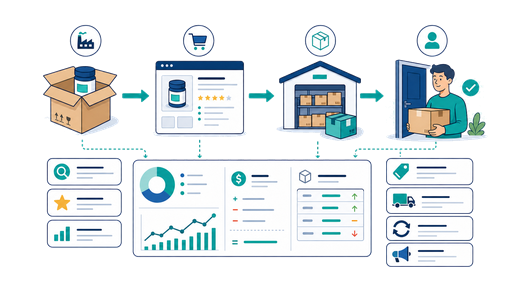
For London Amazon sellers, location matters in a quiet but important way. A glamorous Zone 1 address adds little, while practical access to courier collections, fringe industrial space and reliable staffing can materially change fulfilment speed and operating pressure. Model the business from supplier quote to delivered order, including storage, prep time, return handling and cash tied up in stock. That approach is safer than assuming national marketplace demand automatically creates a viable London-based operation.
Key stats
Platform rules are a cost
Marketplace sellers need to price for fulfilment, advertising, returns, storage and policy changes rather than treating online reach as free demand.
Source: Amazon Seller Central
Cash flow comes first
E-commerce can grow sales while consuming cash through inventory buys, ad spend and delayed payouts.
Source: SBA
Consumer law still applies
Online sellers still need clear claims, returns handling and truthful pricing.
Source: ACCC
Key concepts
London is a good base for specialist sourcing and fast dispatch, but the city is unforgiving if a product only works on optimistic assumptions. Test each line against realistic storage constraints, courier pickups, packaging time and refund risk before expanding the range.
Products that are simple to explain, easy to store and durable in transit are usually easier to scale than bulky, fragile or trend-led items that depend on constant paid traffic.
Think carefully about where stock arrives, where it is checked, how it is packed and what happens when returns come back. A crowded flat, shared building rules or limited loading access can create operational drag long before sales volume looks impressive.
London founders should also test labour assumptions conservatively. Even when the owner does most of the work, picking, packing, customer messages and stock reconciliation are real jobs that deserve time in the plan.
Audience and industry
Customers for a Amazon online store in London should be described by routine, not by broad demographics. Identify who buys, when they buy, how often they return, what alternatives they compare, and how far they will travel. For this business, the first demand hypothesis to prove is search demand, product-market fit and review trust.
London gives e-commerce founders access to suppliers, talent and delivery networks, but it also exposes weak product economics quickly because rent, wages and logistics friction stack up fast. The strongest operators keep the catalogue focused, treat returns as normal and choose practical workspace over vanity location.
Competition in London is not just the nearest similar operator. Include substitutes, online options, supermarkets, gyms, marketplaces, delivery platforms, shopping centres, petrol sites, home alternatives and any business that solves the same customer problem. Visit competitors at the same times you expect to trade.
Key factors
Proof of search demand, product-market fit and review trust in the exact London catchment.
Rent, outgoings, lease obligations and fit-out spend compared with conservative sales.
catalogue quality, fulfilment choice, customer service and stock discipline
gross margin after fees, ads, returns and stock-outs
Enough cash to survive delays, learning, seasonality and slower repeat-customer growth.
Finance model
Business Model Canvas
Specific London customers with repeat need for search demand, product-market fit and review trust.
A Amazon store offer that is easier, faster, more trusted or more local than the alternatives.
Street visibility, local search, referrals, social proof, partnerships, delivery or marketplace channels as appropriate.
Sales driven by search demand, product-market fit and review trust; test price, volume and repeat rate separately.
referral fees, fulfilment fees, advertising, returns and landed product cost; split fixed costs, variable costs and launch costs.
catalogue quality, fulfilment choice, customer service and stock discipline
A suitable site or channel, trained people, reliable suppliers, systems, permits and enough runway.
Landlord, suppliers, advisers, local marketers, delivery or fulfilment providers, and maintenance support.
Evidence-based assumptions, staged spending, conservative break-even checks and clear exit conditions.
Common mistakes
Treating revenue as proof of viability
Measure profit per order after fees, freight, packaging, advertising, returns and fulfilment labour.
Holding too much slow stock
Expand the catalogue only when sell-through data justifies the cash tied up in inventory.
Underestimating returns work
Cost damaged items, relisting effort, customer service and courier friction into the base model.
Case studies
A compact scenario showing how one assumption can change the result.
A compact scenario showing how one assumption can change the result.
Decision tree
Move to rent, capacity and margin stress tests.
Keep researching, pre-selling or testing with a smaller commitment.
Review startup risk, funding and compliance with advisers.
Renegotiate rent, reduce scope, change location or pause.
Prepare a launch plan with measured weekly review points.
Fix capacity, staffing, supplier or process constraints before spending more.
Self-evaluation
Early stage: tighten the assumptions before treating this as feasible.
Decision point
Use the simulator as a structured sanity check. It should support adviser conversations, not replace them.
Test your idea
Where you trade
The guide above works as a planning framework. Confirm the rules, taxes and local context below before you commit.

Checklist
FAQ
Not necessarily. Many founders start from home, shared workspace or light-industrial fringe space, but each option needs assumptions for storage, packing flow, collections and returns.
Because London property, loading access, courier reliability and labour availability affect dispatch speed, storage cost and owner workload even when the sale happens on a marketplace.
Keep advertising as a separate assumption. A product that only sells with paid placement needs a tougher payback test than one with repeat demand and stronger organic search intent.
No. It is early planning support to help you structure assumptions before seeking qualified advice on finance, tax, lease, employment and compliance matters.
Sources
Disclaimer: smallbizsim.com provides indicative planning estimates only. It is not financial, legal, tax or investment advice. Verify assumptions with qualified advisers before making decisions.