Local services win locally
A small service business should validate nearby demand, licences, insurance and the owner’s operating role before buying equipment or fitting out.
Source: business.gov.au
Business guides
Melbourne barbershops work when they become part of a repeat grooming routine instead of relying on one-off curiosity. Brunswick and Fitzroy reward identity and atmosphere, while South Yarra and Carlton can support sharper premium positioning if the service and booking experience feel polished.
Overview
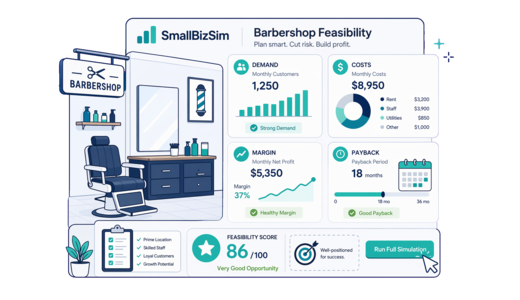
A Melbourne barbershop is a frequency and utilisation business. The real test is how often locals need cuts, whether they prefer walk-ins or bookings, and whether the average service mix can cover rent, wages and fit-out in the exact strip you choose. Separate standard cuts, fades, beard work, premium grooming and retail so the model reflects the labour actually required. A full Saturday does not rescue a weak Tuesday-to-Thursday pattern, so weekday demand matters as much as launch buzz.
Key stats
Local services win locally
A small service business should validate nearby demand, licences, insurance and the owner’s operating role before buying equipment or fitting out.
Source: business.gov.au
Small-business churn is real
Business entry and exit data is a reminder to model slow ramp-up, owner wages and a cash buffer instead of only an optimistic launch month.
Source: ABS
Trust is part of the product
Personal services need visible hygiene, transparent pricing and review discipline because reputation compounds faster than advertising.
Source: Professional Beauty Association
Key concepts
An inner-north destination shop, a CBD lunch-break barber and a neighbourhood family barber all need different hours, price points and brand cues. Write down which routine you expect to serve before you start pricing chairs or signage.
Brunswick and Fitzroy can reward strong identity and word of mouth, while Carlton, CBD edges and tram corridors can lean more heavily on convenience and lunchtime throughput. The site should match the haircut habit, not just the rent budget.
Keep simple cuts, fades, beard trims, kids cuts and premium grooming separate in the forecast. Each one uses different appointment lengths, skill requirements and retail upsell potential.
Owner cover, late cancellations, merchant fees, cleaning and product usage belong in the base case. A premium concept only works when the catchment accepts both the price and the time needed to deliver it consistently.
Audience and industry
Customers for a barbershop in Melbourne should be described by routine, not by broad demographics. Identify who buys, when they buy, how often they return, what alternatives they compare, and how far they will travel. For this business, the first demand hypothesis to prove is repeat local demand, visible catchment fit and sustainable booking or transaction volume.
Melbourne customers compare independent barbers quickly on cut quality, waiting time, vibe and convenience. The market can look crowded, but repeat trust still creates room for a sharp local offer that fits one catchment well.
Competition in Melbourne is not just the nearest similar operator. Include substitutes, online options, supermarkets, gyms, marketplaces, delivery platforms, shopping centres, petrol sites, home alternatives and any business that solves the same customer problem. Visit competitors at the same times you expect to trade.
Key factors
Proof of repeat local demand, visible catchment fit and sustainable booking or transaction volume in the exact Melbourne catchment.
Rent, outgoings, lease obligations and fit-out spend compared with conservative sales.
capacity utilisation, staffing coverage, customer experience, stock or equipment control and repeat sales routines
contribution margin after direct costs, labour pressure and occupancy cost
Enough cash to survive delays, learning, seasonality and slower repeat-customer growth.
Finance model
Business Model Canvas
Specific Melbourne customers with repeat need for repeat local demand, visible catchment fit and sustainable booking or transaction volume.
A barbershop offer that is easier, faster, more trusted or more local than the alternatives.
Street visibility, local search, referrals, social proof, partnerships, delivery or marketplace channels as appropriate.
Sales driven by repeat local demand, visible catchment fit and sustainable booking or transaction volume; test price, volume and repeat rate separately.
rent, wages, supplies, product cost, utilities, insurance and payment fees; split fixed costs, variable costs and launch costs.
capacity utilisation, staffing coverage, customer experience, stock or equipment control and repeat sales routines
A suitable site or channel, trained people, reliable suppliers, systems, permits and enough runway.
Landlord, suppliers, advisers, local marketers, delivery or fulfilment providers, and maintenance support.
Evidence-based assumptions, staged spending, conservative break-even checks and clear exit conditions.
Common mistakes
Assuming visible foot traffic equals haircut demand
Validate how many people in that catchment actually need regular grooming and prefer your service style.
Underpricing skilled services
Match pricing to service time, barber capability, product usage and the positioning the suburb will support.
Treating Saturdays as the whole business
Build the model around repeat weekday trade and use weekend peaks as upside, not the rescue plan.
Case studies
A compact scenario showing how one assumption can change the result.
A compact scenario showing how one assumption can change the result.
Decision tree
Move to rent, capacity and margin stress tests.
Keep researching, pre-selling or testing with a smaller commitment.
Review startup risk, funding and compliance with advisers.
Renegotiate rent, reduce scope, change location or pause.
Prepare a launch plan with measured weekly review points.
Fix capacity, staffing, supplier or process constraints before spending more.
Self-evaluation
Early stage: tighten the assumptions before treating this as feasible.
Decision point
Use the simulator as a structured sanity check. It should support adviser conversations, not replace them.
Test your idea
Where you trade
The guide above works as a planning framework. Confirm the rules, taxes and local context below before you commit.

Checklist
FAQ
Brunswick and Fitzroy suit identity-led barbershops with strong local personality, while Carlton, CBD fringe strips and South Yarra can support convenience or premium grooming depending on the exact frontage. Choose the catchment where repeat haircut routines, not just passing traffic, are easy to prove.
Separate standard cuts, fades, beard work, kids services and retail so appointment length and staffing stay visible. Then test utilisation by chair and by daypart instead of assuming every open hour will be productive.
Check lease use, fit-out approvals, health and hygiene expectations, signage rules, employment obligations, public liability insurance and any music licensing before spending heavily on the shopfront.
No. It is early planning support to help you structure assumptions before seeking qualified advice on finance, tax, lease, employment and compliance matters.
Sources
Disclaimer: smallbizsim.com provides indicative planning estimates only. It is not financial, legal, tax or investment advice. Verify assumptions with qualified advisers before making decisions.